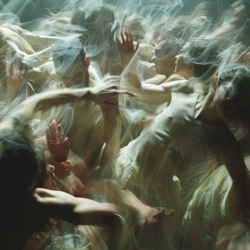
“Canes of Karabakh” – Sound, Fragility, Tradition / CD / Crossroad Publications
“Canes of Karabakh” is the debut album by the Polish music project of the same name, operating at the intersection of avant-folk, post-rock, and experimental music. At the heart of this narrative is the duduk, an ancient wind instrument whose voice is at once soft, deeply human, and primal. The album was released on January 25, 2026 by the Crossroad Centre for Intercultural Creative Initiatives.
Context of the album’s creation
The album title refers to Nagorno-Karabakh, the region from which the reed used to make duduk reeds (gamish) originates. This material is crucial to the instrument’s sound, determining its timbre, depth, and pitch stability.
After Armenia’s defeat in the war over Nagorno-Karabakh, access to this reed was significantly reduced and the prices of reeds doubled. In practice, this means that an instrument that for centuries has been part of local culture has become harder to access, especially for Armenians themselves.
For the creators of Canes of Karabakh, this became a moment of reflection and awareness of how strongly music and tradition depend on political and economic conditions. The project thus turned into a meditation on who can use heritage rooted in a specific place today, and under what conditions, and on how easily cultural continuity can be disrupted by events beyond artists’ control.
“We want Canes of Karabakh to be a modest musical note, a way of drawing attention to the fragility from which the power of the duduk grows, an instrument with a history of well over a thousand years. We deliberately avoid traditional melodies, fully aware of their importance and feeling that we are unable to do them justice. We focus solely on the sound of the duduk correlated with the sound of the trumpet. This sound itself is the subject of our musical work.”
— The band
The breath of the duduk and space
Canes of Karabakh do not recreate traditional Armenian melodies. With full awareness, they refrain from quoting the canon, acknowledging its significance and its inaccessibility to outsiders. Instead, they focus on the sound of the duduk itself, its texture, breath, instability, and drama, juxtaposing it with the flugelhorn and electronics.
The result is open, meditative, often raw music, in which sound does not lead to a climax but disperses over time. Electronics do not dominate the acoustic instruments. They function as echo, space, and an extension of breath. It is a dialogue between past and present, between the organic and the produced.
Band lineup
The project is created by:
-
Stanisław Matys, duduk
-
Olgierd Dokalski, flugelhorn, trumpet, SFX
-
Paweł Bartnik, electronics, production, mixing
The band’s story grows out of Matys’s personal experience. He learned to play the duduk from a close Armenian friend, Narek. It was from him that he learned about the dramatic rise in reed prices and about how war directly affects access to the instrument and the ability of local musicians to continue the tradition.
A demanding and beautiful album
“Canes of Karabakh” is an unorthodox and demanding record. As Piotr Wójcik notes, it is not a proposal for every listener and certainly does not aspire to the mainstream. Its strength lies in the experimental treatment of the duduk, ranging from nostalgia and rawness to almost deconstructive sound practices.
This is music that reveals its beauty gradually. It requires attentiveness, returns, and a readiness for sound not to guide but to hold the listener still. Like the titular reed, delicate yet resonant, it carries both the drama of history and the silence in which meaning is born.
Second prize at Nowa Tradycja and the premiere
Even before the album’s release, Canes of Karabakh won second prize in the “Nowa Tradycja” competition organized by Polish Radio Program Two in 2025. The jury recognized the band for building sound space, a consistent inward focus on timbre, and a conscious expansion of musical language.
The album premiere coincided with a concert at the Władysław Szpilman Studio of Polish Radio in Warsaw on January 25, 2026, organized by Polish Radio Program Two and its partners.
Publisher’s voice
“There are sounds that do not want to be just music. They emerge from the depths of the air, as if they remembered times when breath was still a prayer and silence was the space where meaning is born. (…) The duduk faithfully guides the listener. From its reed body flows a breath that carries something of the earth and something of infinity.”
— Grzegorz Paluch, Crossroad Centre
We had the opportunity to encounter Canes of Karabakh during last year’s KODY Festival, organized by our Crossroad Centre, directed by Piotr Franaszek, with Grzegorz Paluch as curator.
Release
A limited vinyl edition of the album “Canes of Karabakh – Trzciny Karabachu” was also released by the Crossroad Centre in 2026.
“Canes of Karabakh” is not only an album but a musical testimony, a record of attentiveness, ethical reflection, and an attempt to meet tradition without appropriating it. It is a story about breath that remembers more than we are able to express in words.
The CD is available for purchase in our shop. The vinyl edition will be available soon.