“Spy Girls”, directed by Magda Szpecht
A performance that provokes, unsettles, and forces the audience to confront difficult questions
This performance is a must-see for those who want to understand what the war of narratives on the internet looks like today, because we live in a world in which the sense of security is nothing more than an illusion.
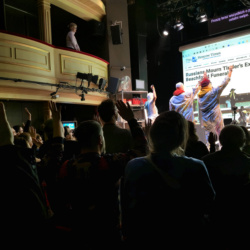
The performance “Spy Girls”, directed by Magda Szpecht, had its Polish premiere on 5 December in Lublin, as part of PERCEPCJE. New Forms of Art, a festival curated and guided by its “good spirit”, Barbara Żarinow
https://www.instagram.com/percepcje_nowe_formy_sztuki/
“Spy Girls” is a performance about the illusion of safety. Rather than merely telling a story about the world of digital deception, it enters that world itself, at its own risk. It shows how easily online identity can be constructed with the help of artificial intelligence, how smoothly one can move from flirtation to manipulation, and finally how thin the line is between performance and action that is almost political. Because this is not only a performance, but a project that has an impact on reality.
The idea for the performance grows directly out of the director’s earlier activity as a “cyber-elf” engaged in the fight against online disinformation: tracking fake news, confronting trolls, and exposing mechanisms of influence.
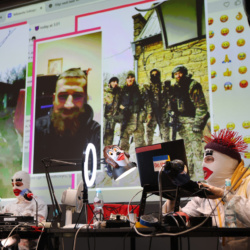
Magda Szpecht and actors from the Estonian Vaba Lava Theatre carried out weeks of undercover actions. They created fake accounts and, posing as attractive young women, entered into relationships with social media users, mainly soldiers, in order to extract information or disrupt propaganda narratives. By testing mechanisms of trust and manipulation, they gathered material for the performance.
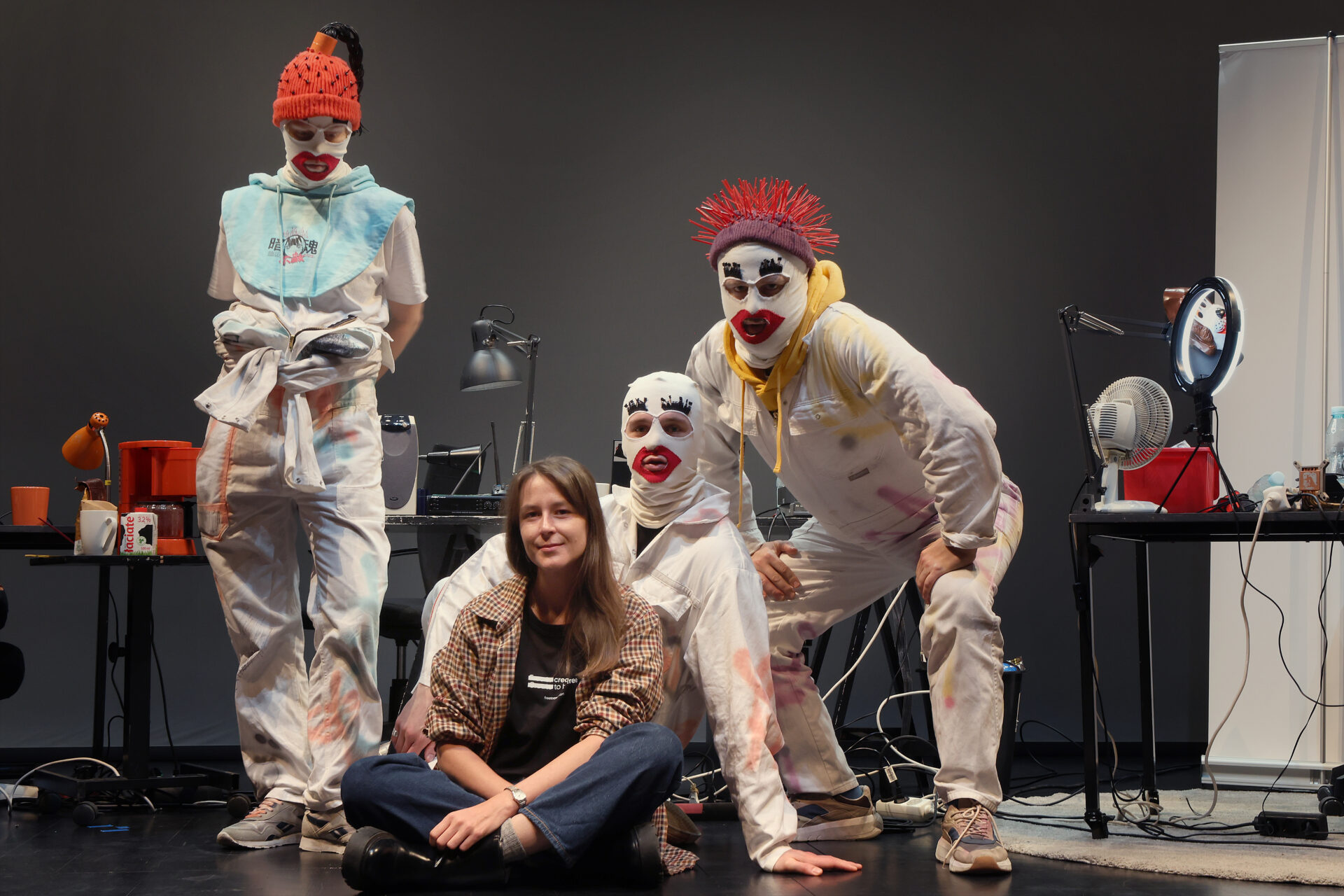
On stage, the actors wear masks, maintaining anonymity and protecting their identities. This is a conscious strategy, but it also raises questions about responsibility. Who bears the consequences of collecting and revealing data? What are the legal and moral boundaries of actions that, in the real world, may expose people to danger?
For this reason, the performance does not offer answers. Instead, it poses uncomfortable questions and places the audience within their space: is flirting with a Russian soldier in order to provoke or ridicule him a form of resistance, or an abuse? Is intention (“we are doing this to support Ukraine”) sufficient to justify manipulation, lies, and the emotional exploitation of another person? In the conditions of war, does access to information become a value more important than the principles we follow in times of peace? Does the end justify the means?
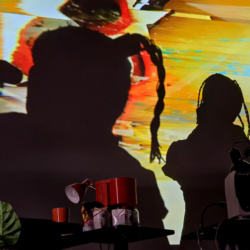
Another layer of “Spy Girls” that cannot be overlooked is its use of contemporary AI technologies in theatre. Artificial intelligence allows the boundaries between “real” and “unreal” situations to blur: voice-changing technology, video manipulation, and elements of auto-generated imagery. This is the moment when classical theatre as a form encounters a new reality, a world in which the boundary between truth and fiction, communication and manipulation, becomes fluid. Can we trust what we see and hear? Are we able to recognise when a human is a human, and when it is a generated persona?
Here, artificial intelligence does not appear merely as a new kind of mask that allows for more effective action, but also as something that strips humans of a sense of their own agency. The performance shows that in an era of generated images and manipulated identities, the concept of truth becomes negotiable. It is precisely here that the greatest danger emerges.
In this sense, the performance becomes a kind of cultural experiment, a performative act that reveals how profoundly technology (the internet, social media, disinformation, AI) is transforming the rules of war, privacy, and ethics, and what it means to be human in an era in which identity can be reduced to code.
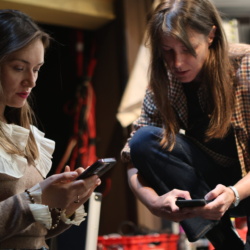
There is yet another context to the creators’ actions: how power is constructed on the microscale of a single chat conversation, how a female avatar can keep a soldier engaged in a chat for an hour, how emotional dependence can arise within the exchange of just a few images, how a joke turns into a tool, and what a person is willing to do when the internet provides tools without immediate consequences.
Thus, Magda Szpecht’s “Spy Girls” provokes, unsettles, and compels audiences to ask difficult questions about the limits of responsibility and ethics in engaged art. This is not merely a formal experiment, but a project that affects reality.
All the seemingly illusory situations used in the performance were real, based on archived conversations and actual social media accounts. Undoubtedly, their authenticity is the performance’s greatest strength.